Necessary Understanding
This primer assumes you know a modest amount of 12 TET music theory. While you certainly can explore alternative scale systems without any theoretical knowledge, it's difficult to understand concepts like chords and notation without this knowledge. You should know scales, chords, keys, and basic music notation knowledge. However in order to grasp how a 17 TET system might behave as opposed to a 12 TET one, we need to go back to the very basics of music ignoring rhythmic concepts of course.
Steps and Accidentals
You probably know about whole steps and half steps from 12 TET music theory right? A whole step is two chromatic pitches while a half step is one. For example, C to D is a whole step but C to C# is a half step. 17 TET takes this a step further and considers not two but three step sizes. They are half steps, whole steps, and "mid steps."
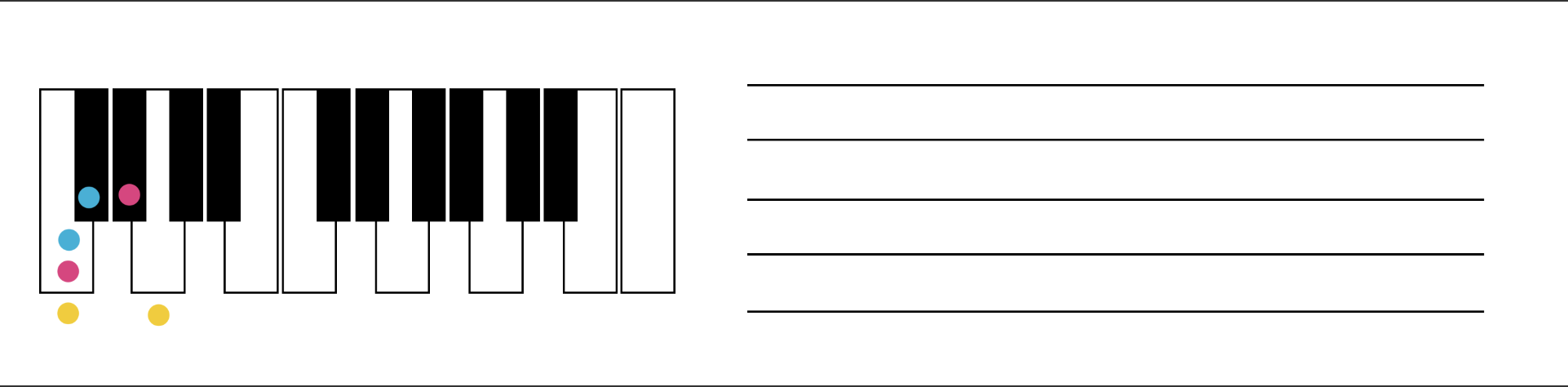
A Half-Step of "Semitone" is the distance from one note in 17 TET to another. It is one-third the distance of a whole step. A Mid-Step or Mid-tone is the distance of two notes in 17 TET and is two-thirds the distance of a whole step. A whole step or Whole-tone is the distance of three notes of 17 TET.
Half steps in blue, Mid steps is red, and whole steps in yellow:
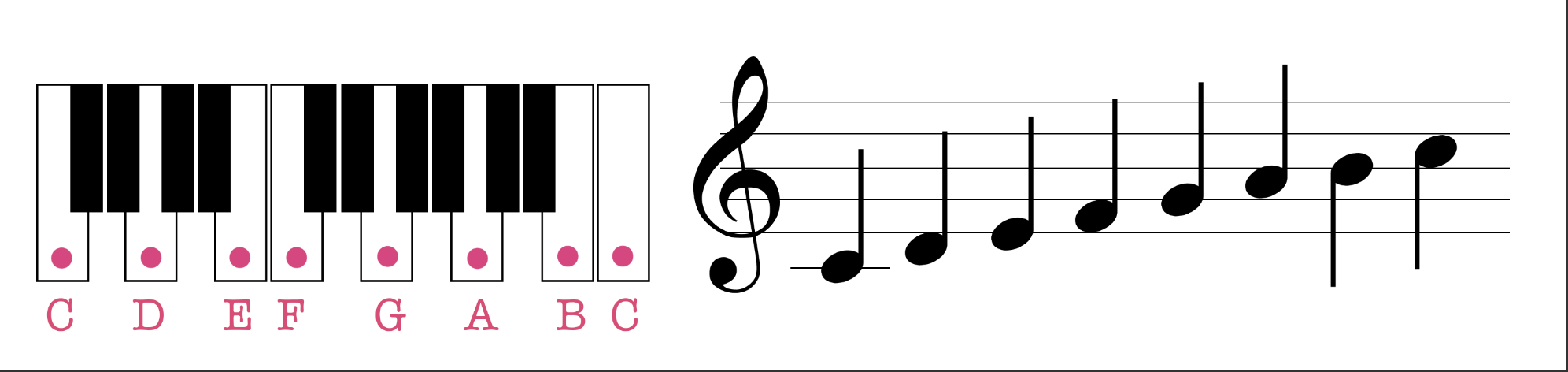
The white keys on the 17 tone piano layout correspond to the same letters as the 12 TET white keys do. The naturals C D E F G A B C are based on a chain of fifths just like in 12 TET. That means the white keys also correspond to the same major scale but the way the major scale is tuned is quite different from 12 TET.
There are no mid steps at all between the naturals in 17 TET. They must be indicated by accidental signs. The 17 TET version of the major scale follows the exact same structural pattern W W h W W W h as 12 TET but now the whole steps are much wider and and the half steps are much narrower than they are in 12 TET.
Accidentals in 17 TET are a bit different than 12 TET. In 12, a sharp or flat corresponds to one pitch difference but in 17 it refers to a two pitch difference. The one pitch difference uses a pair of accidentals called "Vai" and "Vao" which are part of the sagittal system which is universally understandable across different tuning systems. Vao means down one pitch while Vai means up one pitch.